Ultra-high-resolution wall-sized displays feature a very high pixel density over a large physical surface, typically covering a few square meters. They provide effective support for collaborative work sessions that involve the visualization of large, heterogeneous datasets, and are particularly well-suited to the visualization of cartographic and geospatial data at large.
WildMap is a framework to create Web-based geovisualizations on cluster-driven ultra-high-resolution wall-sized displays such as the WILD-512K and WILDER platforms at Université Paris-Saclay and Inria.
The ultra-high display capacity of these interactive walls means that compared to more conventional desktop display setups, the same spatial region can be visualized with a much higher level of detail, which can be of key importance as cartographic representations often feature many small elements and subtle visual cues. Put another way, this increased display capacity means that for a given level of detail, a much larger spatial region can be visualized.
WildMap builds upon wild-osd, also developped at Inria. It enables plotting arbitrary geo-located elements on top of tile pyramids. Those elements can be rendered in SVG or in WebGL, and can be manipulated interactively.

Code
WildMap is hosted on Inria's GitLab platform and released under a BSD-3-Clause license.
Examples
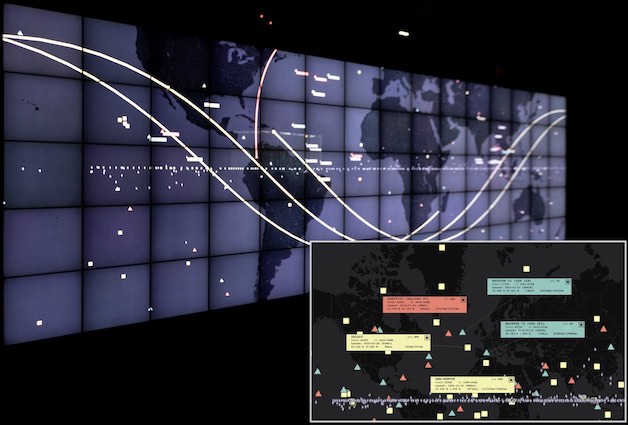
We have developed applications that demonstrate:
- Marine traffic visualization (AIS data feed);
- Satellite orbit visualization (TLE data feed);
- Earth exploration with mapbox vector tiles (MapboxGL).
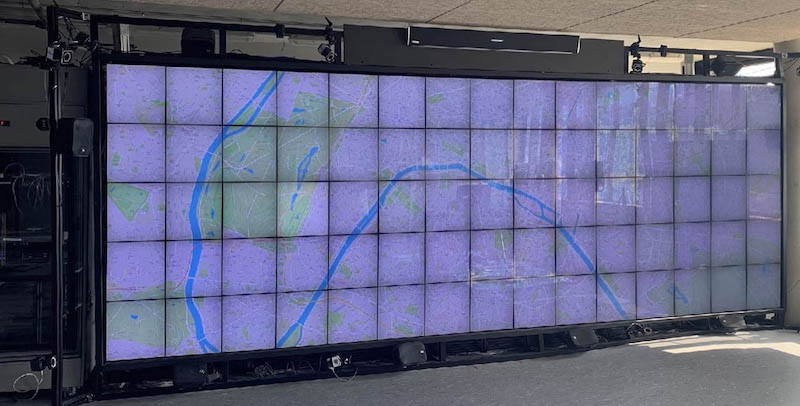
MapboxGL vector tiles rendered with WildMap.
These applications have so far been tested on thr following configurations:
- WILDER: resolution 14250 x 4750 px; driven by 10+1 Linux-operated PCs
- WILD-512K: resolution 61440 x 17280 px; driven by 16+1 Linux-operated PCs
Dependencies
WildMap depends primarily on Node.js for synchronization between computers in the cluster, OpenSeaDragon for tile loading an rendering, and D3.js for populating overlays on top of maps when drawing in SVG. It also uses TypeScript for coding.




Resources
- Keynote talk at ACM EICS 2022, and the associated abstract in the ACM Digital Library (direct link to PDF).